← all systems · case file 04 · screen_risk() · Live on HF Spaces · Zenodo Preprint
PredictLab
From raw health data to real insights.
Summary
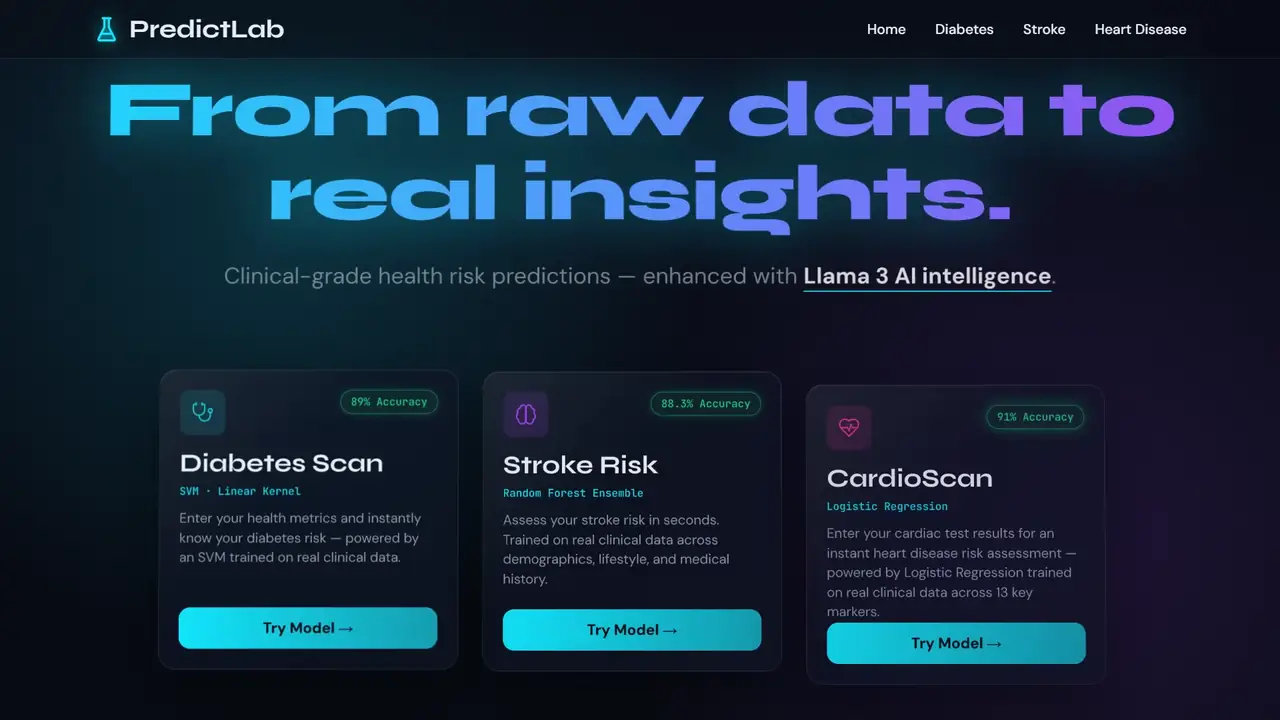
A containerized, full-stack clinical risk screening platform on Hugging Face Spaces. Three scikit-learn classifiers screen for diabetes, stroke and heart disease across 30 clinical inputs, and Llama 3.1 8B on Groq explains each result in accessible language. Published as a research preprint on Zenodo in May 2026.1Live demo on Hugging Face
| Value | What | Method | Source |
|---|---|---|---|
| 3 | Clinical screening models | An SVM (diabetes), a Random Forest (stroke) and a Logistic Regression (heart disease), each a scikit-learn pipeline behind one FastAPI service. | [2] repo |
| 30 | Health inputs analysed | Input fields across the three screening forms: 8 + 10 + 12. | [2] repo |
| Preprint | Published on Zenodo, May 2026 | Zenodo record v1.0, 17 May 2026. A preprint, not peer-reviewed. | [3] doi |
Problem
A bare 'Diabetic / Not diabetic' output raises more questions than it answers for anyone without a medical or machine-learning background.1Live demo on Hugging Face
Architecture
SVM, Random Forest and Logistic Regression behind one FastAPI service; Llama 3.1 explains each result
01Three disease models
An SVM for diabetes, a Random Forest for stroke and Logistic Regression for heart disease, each in its own scikit-learn pipeline.
02One FastAPI service
A single FastAPI backend serves the web interface, the prediction endpoints and the AI assistant with no frontend build step, containerized with Docker.
03Contextual explanations
Patient inputs and model outputs go to Llama 3.1 8B on Groq, which explains the result in plain language and answers follow-up questions.
Not claimed
- Can it diagnose me?
- No source says it diagnoses anything, so I won't say it does. It's a screening tool that explains risk. For a diagnosis, see a doctor.
Sources
source [1] · Interactive Demo · PredictLab
Live demo on Hugging Face
huggingface.co/spaces/VINAYAKKV/Predict-Ai
source [3] · Research Preprint · PredictLab
Research preprint (Zenodo DOI)
doi.org/10.5281/zenodo.20253956